YOGA BLOG
What Moves Us…..

Richard's Asana Breakdown ASHTAVAKRASANA
EIGHT CROOK POSE (Ashtavakrasana, pronounced ash-TAH-vuh-KRAH-suh-nuh)
ashta = eight
vakra = crooked, twisted
This pose is named after a character in the great Indian epic poem, the Mahabharata. His story isn’t a completely pleasant one, though it all turns out well enough in the end.
EIGHT CROOK POSE (Ashtavakrasana, pronounced ash-TAH-vuh-KRAH-suh-nuh)
ashta = eight
vakra = crooked, twisted
This pose is named after a character in the great Indian epic poem, the Mahabharata. His story isn’t a completely pleasant one, though it all turns out well enough in the end. Ashtavakra was the son of Kahoda, who was so devoted to his studies that he entirely neglected his wife, who was pregnant with Ashtavakra. The unborn child rebuked his father for neglecting his mother, which of course requires a willing suspension of disbelief, but it is, after all, a poem. Kahoda, instead of recognizing and correcting his inconsiderate behavior, became angered at his son for what he perceived as impertinence and condemned him to be born crooked, which he was in eight places. This isn’t the only example in Indian story-telling of a father cursing his son for calling him out. You might turn to chapter 1 of the Katha Upanishad, where you’ll read of Ushan’s treatment of his young son, Naciketas. It’s literally a hell of a story.
Anyway, as I said, the story has a relatively happy ending. Ashtavakra grew to be a very wise 12-year-old, and after winning a debate with a Buddhist sage, was instructed to bathe in the Samanga River, and was immediately straightened out.
Ashtavakrasana doesn’t appear to be a traditional pose. The oldest reference to it I found was in the Yoga Rahasya (Secret of Yoga), probably written in the 1920s or 1930s by T. Krishnamacharya. It bears some resemblance to another asana in that text, Kaundinyasana. Both of these poses are pictured but not described. You can, however, find them described in BKS Iyengar’s modern classic Light on Yoga (LoY, Iyengar undoubtably learned these poses from Krishnamacharya, his guru). Ashtavakra is #123, Koundinyasana (slightly different spelling, and named Dvi Pada Koundinyasana) is #158.
As you may know, each pose in LoY has a numerical “difficulty rating” based for some unexplained reason on a scale of 60 (coincidentally, I assume, the first number system invented by the Sumerians more than 5,000 years ago, was base 60). It’s often the case that the ratings, at least for the average Western student, are way too low, giving the impression that a rather challenging pose is fairly easy. The most glaring example, in my opinion, is Lotus (padmasana), which is rated at 4. Ashtavakrasana is a 13, which seems a bit low, rated not that much higher than a simple standing forward bend (uttanasana), an 8.
PREPARATION
It might be helpful, before trying the pose, especially for the first time, to try this simple preparation. Sit on the floor, legs stretched forward, hook your ankles, right in front of the left (the ankle of the bottom leg is hooked in front of the ankle of the top leg), and squeeze a block at its narrowest width between your thighs. Exhale, turn your torso to the right, press your hands widely on the floor, roll over onto your outer right hip and leg. Keeping your torso perpendicular to your legs, and with another exhale, lower your torso almost to the floor, hands wide to the sides, elbows more or less at right angles. Firmly press your ankles together and squeeze the block, reaching out through your heels. Your feet may lift slightly off the floor. Press your inner hands firmly to the floor and reach out from your mid-back through your elbows as if your arms were rooted in your spine. It’s probably best to look down at the floor. Hold for 30 seconds to a minute, then inhale and push yourself back to upright. Change the cross of your ankles, repeat to the left side for the same length of time, and again come up with an inhale. Remove the block, straighten your legs, and bounce your knees on the floor a few times.
USE OF PROPS
Now you may need some help with this pose until you get the hang of it. You could, for example, position a block, either at its lowest or middle height, where it’ll be directly under your sternum when you lower your torso. Instead of a block, you could lay a bolster on the floor perpendicular to your legs. Alternatively, you might position yourself on a bolster so that when you turn to the side, the length of your outer right hip and leg will be supported on the bolster.
FULL POSE
If you feel confident, however, that you have sufficient strength and balance needed for the full pose, then certainly try without any props. If you look at Mr. Iyengar’s photos of him doing this pose, you’ll see he enters it somewhat differently than what I’m about to describe. That’s because even in my salad days, I didn’t quite have the flexibility in the groins needed to do what he shows. I can only teach what I know, so if you want to follow Mr. I’s lead, consult LoY.
Again cross your right ankle over your left, and this time insert your right arm between your legs, just where you had the block, and work the back of your right arm or shoulder deep into the inner right leg. Then as you turn right and lower the torso with an exhale, squeeze your arm as you did the block and reach out through your heels. You don’t really need as much strength to lift into the pose as you might think. Just by squeezing your arm and reaching through your heels should be enough to elevate you into the pose.
Initially, hold for 30 seconds and release back to the floor with an inhale. Over time you might gradually increase your stay in the pose to a minute. When finished to the right, reverse these instructions and repeat to the left. When finished, again sit with legs stretched forward and bounce your knees on the floor. Be careful what you say to your father.
BENEFITS
According to LoY, Ashtavakrasana strengthens the wrists and arms and tones the abdominal muscles.
CONTRAINDICATIONS
Avoid this pose if you have any wrist, elbow, or shoulder injuries.
SUGGESTED PREPARATORY POSES
Standing Forward Bend (Uttanasana)
Four-Limbed Staff Pose (Chaturanga Dandasana)
Bound Angle Pose (Baddha Konasana)
Side Angle Stretch (Parshvakonasana), with the bottom arm pressing the inside of the forward leg

Richard's Asana Breakdown UTTHITA TRIKONASANA
UTTHITA TRIKONASANA
uttihita = extended
tri = three
kona = angle
asana = literally “seat,” usually interpreted as “pose” or “posture”
It’s not uncommon in the long history of yoga asanas for several much different poses to have the same name. Such is the case with trikonasana, popularly known today as Triangle Pose. According to the Encyclopedia of Traditional Asanas, trikonasana is the name of four different poses. Two of these four are fairly similar–and what seem to be very uncomfortable–sitting poses. The first looks like a wide knee Hero Pose (virasana), with the feet set slightly away from the hips and turned onto their inner edges (everted). The second is a variation of the first, with just one leg in the position just described. The third is a squat in which the elbows rest on the knees and the head is held in the hands. The fourth is the standing pose we all know so well.
Our trikonasana, in comparison to a venerable pose like Lotus (padmasana), which is more than 1,500 years old, is a baby among the stock of asanas, likely added not much more than 100 years ago. The pose is aptly named. Typically we see in it a pair of triangles, one formed by the two legs and the floor, the other by the front leg, the underside of the torso, and the bottom arm. But if we look closely at Mr. Iyengar’s photo of the pose in Light on Yoga (plate 5), we see there’s actually a very small third triangle, the formation of which needs a slightly wider stance than most of us take. If we do widen out a few inches more, then the bottom hand can be pressed to the floor behind the front foot’s heel, and voila, triangle number three.
PREPARATION
To begin, step (or hop) your feet apart. The usual distance given is about a yard (or meter), but this is only an approximation, the proper distance for you will depend in large part on your height and length of your legs. Shorter students might have the feet somewhat closer, taller students somewhat wider.
By convention in the Iyengar school, the two-sided poses are always performed to the right side first. A teacher once told me this is done because the word “right” in Sanskrit is dakshina, “able, clever dexterous,” a symbolic meaning that gets the pose off on the right foot, so to speak. Left, on the other hand, is vama, “perverse, vomiting,” a much less appealing leading thought. It seems to me though this is one more example of the ancient prejudice against lefties, and so to all you southpaws out there, if you want to start to the left, feel free to do so.
Once the feet are placed at the appropriate distance, they’re rotated to the right, the left foot just slightly, the right foot, as convention has it, 90 degrees, so that the inner edge of the foot is parallel to the long edge of the mat toward which you’re facing. Your pelvis should also turn slightly to the right so the left hip is closer to that same long edge.
This instruction, to slightly rotate the pelvis was at the center of a heated controversy many years ago. Back then it was generally taught that the hips should be “flattened,” as if the pelvis were secured between a pair of parallel plates. But this positioning tended to inwardly rotate the front thigh, which in turn twisted the front leg knee, a hinge joint, out of its crucial alignment with the ankle. Repeated over time, this twisting could potentially lead to knee problems. Some teachers then wisely began to instruct students to allow the back hip to come as far forward as needed to outwardly rotate the front thigh and maintain the knee-ankle alignment. The “press back” instruction was transferred to head of the back leg’s thigh bone (femur). I strongly urge you to follow this instruction, not only in trikonasana but in the other two-sided standing poses like virabhadrasana 2. Be sure though that as you rotate the front thigh, you press the base of the big toe firmly against the floor to keep the weight on the inner foot.
The standard alignment of the feet has the front foot heel in line with the back foot arch. What isn’t often recognized, though, is that even with both feet on the floor, many of the standing poses, like trikonasana, are balancing poses. So if you feel a bit unstable with this heel-to-arch alignment, then it’s acceptable to slightly widen your base of support and align the front heel with the back heel.
When the feet and pelvis are properly positioned, it’s almost time to move into the pose, but one more thing is needed. Every pose has an anchor, and for standing poses like trikonasana, it’s the back heel. To create this anchor, press the inner left thigh actively off to the left to ground the outer left heel firmly to the floor. This grounding can be intensified if you also press your back heel to a wall. If you use a wall in this way, be sure after exiting the pose not to step forward directly onto the front foot. Always turn the feet forward to parallel, balance the weight between them and step or hop them together.
MOVING INTO THE POSE
Now inhale your arms up parallel to the floor, palms down, being careful not to raise your shoulders as well. Then with an exhale, from your anchored heel start to stretch out through the right arm. Keep your torso over the plane of the forward leg, imagine the legs drawing to the left as your torso extends to the right.
As you do this, draw an imaginary line of energy up along the inner right leg from the ankle to the groin, then continue this line through the pelvis to the left hip (imaginatively draw the inner left leg up from ankle to groin to help maintain the strength of the foot’s inner arch). At the same time, release the head of the right thigh bone deeper into the pelvis to encourage the length along the under side of the torso. Remember that trikonasana isn’t a side bend, and once in the pose, both sides of the torso should ideally be more or less equally lengthened.
Unfortunately, less experienced students are often reluctant to use props and have their heart set on pressing their bottom hand to the floor. But many don’t have the flexibility to do that comfortably, so the torso ends up in a side bend, the upper side overstretched, the under side compressed, a reflection of what’s happening to the spine. This is certainly not ideal. In each and every pose, the attempt should be made to re-create a Mountain Pose (tadasana) spine, that is, evenly extended front and back and along the sides. If a side bend is what happens when you bring your hand to the floor, I highly recommend you support it on a yoga block, positioned at a height against which you can spread your palm and press it flat. Doing so with your palm on the block will create a response in the shoulder blade, which will widen across and firm into your back, helping to support the lift of the chest. More importantly the two sides of your torso–and your spine–will be much more evenly lengthened.
The position of your arms depends on the angle of your torso relative to the floor. For beginning students, the torso is usually at a slight angle. The arms then should be parallel to the line of the shoulders. Only when the torso is more or less parallel to the floor should the arms be stretched perpendicular. You might also imagine there’s a wall right in front of you and “press” your top hand against it, using the imaginary resistance to do with the top hand’s scapula just what you did with its bottom mate. Keep all the fingers pressed together
The rotation of the head to look up at the top hand is a tricky movement. If you have any neck issues at all, major of minor, it’s best to keep your head neutral and gaze straight forward. If you do rotate the neck, always be sure to start with a neutral neck, that is, with the two sides (like the sides of the torso) evenly lengthened, and bring your chin close to the top shoulder. Never turn your head from a drooping neck.
It’s usually recommended to stay in the pose anywhere from 30 seconds to a minute, but longer stays are not unheard of. Always breathe as slowly and smoothly as possible in the pose, rough breathing indicates struggle, something you want to avoid no matter what the pose. Come out of the pose with an inhale, pressing down heavily with the back heel and reaching up with the top arm. Try not to wobble.
It’s beyond the scope of this breakdown to detail the symbolism in yoga of the triangle. Briefly then, as
Betty Heimann writes, geometrical symbols–triangles, circles, squares, and the like–are “equivalent to the concrete personal expression of the unapproachable Divine,” often used as “seeds” for meditation. An upward pointing equilateral triangle represents the fire element and the universal human urge to transcend the material world. Its downward pointing opposite represents water and the contrasting urge of the Self to become embodied. When these two triangles are interpenetrated the world is created, when separated the world disappears.
Richard's Asana Breakdown BHARADVAJASANA
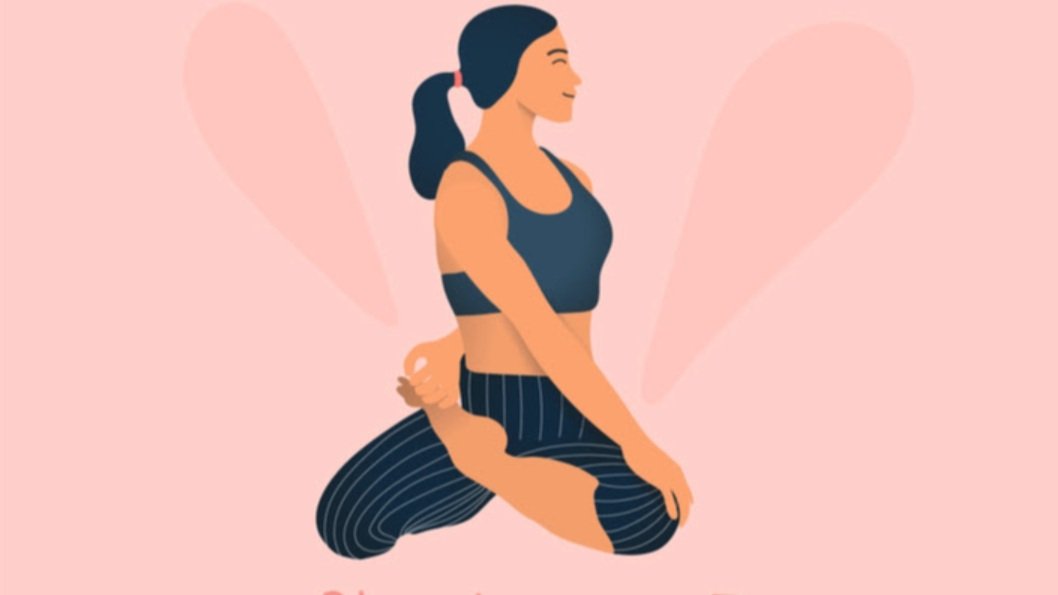
BHARADVAJASANA
(bah-rod-VAH-JAHS-anna)
Bharadvaja (pronounced bah-rod-VAH- jah, emphasis on the third syllable) consists of two words bharat (“to carry, bear”), and vaja (“strength, speed”). (Note that the first word, by itself, ends with a “t.” But when when joined to another word beginning with a consonant, here a “v,”
Sanskrit changes the “t” to “d”). Literally then, Bharadvaja means “bearing strength or speed,” which the dictionary further interprets as “skylark.”
BHARADVAJASANA
(bah-rod-VAH-JAHS-anna)
Bharadvaja (pronounced bah-rod-VAH- jah, emphasis on the third syllable) consists of two words bharat (“to carry, bear”), and vaja (“strength, speed”). (Note that the first word, by itself, ends with a “t.” But when when joined to another word beginning with a consonant, here a “v,”
Sanskrit changes the “t” to “d”). Literally then, Bharadvaja means “bearing strength or speed,” which the dictionary further interprets as “skylark.”
Bharadvaja is remembered as a rishi, an inspired “seer,” who tradition credits as the author of 53 of the 1028 hymns in the Rig Veda (“knowledge of praise”), Hinduism’s holiest book. Here’s a very brief sample of one, dedicated to the Dawn (6.54):
The radiant Dawns have risen up for glory, in their white splendour like the waves of waters.
She maketh paths all easy, fair to travel, and, rich, hath shown herself benign and friendly.
It’s said Bharadvaja now resides with six other rishis in the seven stars of the Big Dipper.
The traditional pose is described in a pair of nineteenth century texts, the Shri Tattva Nidhi (“Blessed Treasure of Reality,” which translates bharadvaja as the “crow pheasant”) and the Hatha Abhyasa Paddhati (“Way of Hatha Practice”). In both texts, the description is corrupt, but from what we can tell, the legs seem to be arranged in Lotus (padmasana). The earliest version I found of the pose described here, and there very well could be earlier books I’m not aware of, is Mr Iyengar’s Light on Yoga, published in 1966. The second version (again, there may be earlier books) is found in the Yoga Rahasya (“Secret of Yoga”), written sometime in the first decades of the twentieth century, most likely by T. Krishnamacharya.
WHAT YOU MAY NEED. A blanket, a yoga strap, and a weighted bag.
Sit on the floor with your legs straight out in front of your torso in Staff (dandasana). Shift onto your right buttock, bend your knees, and swing your legs to your left. Lay your feet on the floor just outside your left hip, with your left ankle resting in the inner arch of the right foot. You may find yourself tilting precariously to the right, known as the Leaning Tower of Bharadvaja, which curves the spine and so hampers the pose to a greater of lesser degree. If you are leaning, wedge a thickly folded blanket under your right buttock, which should help bring your left buttock at least closer if not onto the floor. You might also lay a weighted bag over your left hip crease to anchor the thigh even more. This will help bring the pelvis to a more or less neutral position.
What’s so important about that? For any twist, we need to prepare by lengthening our spine evenly as much as possible, front and back, side to side, which can only be realized when the pelvis is relatively neutral (this also frees the diaphragm to pump maximally). The trick is to move the top of your sternum and your tail bone in opposite directions, the former up and the latter down. Make sure though that you don’t simply push the lower ribs forward to achieve the former action (which lifts the bottom of the sternum, overarching the lower back), or “tuck” the tail bone for the latter, which flattens the lower back. To achieve the tail bone action, imagine it lengthening downward like a long kangaroo tail,
Then exhale and twist your torso to the right, keeping your left buttock on or very close to the floor. Remember that all twists are rooted in the groins, not the lower back and belly. Imagine initiating the twist then from the left side of the sacrum, so the left hip point moves over the anchored left thigh toward the knees. The pelvis in twists always turns with the rest of the torso.
As you near the end of your twist, you may feel your belly “thickening,” much like what happens when we twist a dish towel. If you feel this, stop, de-rotate the torso slightly, re-affirm the anchoring of the thigh bone and the lengthening of the spine, and imagine drawing your belly out from the depths of the pelvis. Then try moving into the twist again. The sides of your torso are another good indicator that your spine is or isn’t lengthening evenly. If your pelvis isn’t well anchored by the left thigh when twisting right, the ribs will bow out on the right side and shorten on the left. You might be able to slightly deepen by pressing down on the left femur, as you draw your right ribs in and lengthening your left side.
Now clasp your right knee with your left hand, and press your right fingertips on the floor just beside your right buttock. Pull your left shoulder back slightly, and press your shoulder blades and right elbow firmly against your back, even as you continue to twist your chest to the right. Your shoulders ideally should look as they do in Tadasana. You can turn your head in one of two directions: continue the twist of your torso by turning it to the right; or counter the twist of your torso by turning it left and looking over your left shoulder at your feet.
If you want to take the pose a bit farther, inhale and sweep your right arm behind your torso. It may be possible to clasp your upper left arm with your right hand, but if you can’t do this easily, use a strap. Begin the twist with the strap held as a large loop in your right hand, make the turn, and slip your left arm through the loop before clasping your knee. Then move your right hand along the strap until it’s as close to your left arm as you can manage without struggling. Be sure to keep pressing your right elbow into, not away from, your back. If you want to go even a bit farther, press the back of your left hand against your right knee, then slip it under the knee and press your palm to the floor.
EXITING. Stay for 30 seconds to 1 minute, then release with an exhale, return to the starting position, stretch your legs forward (always be sure to return to neutral between the two sides of a pose) and repeat with a twist to the left for same length of time, reversing all instructions.
FOR INTERMEDIATE STUDENTS. Bharadvajasana II
CAUTION. Anytime you perform either a full or half Lotus (padmasana), the latter of which is needed for this pose, please be sure your hips are sufficiently warmed up to protect your knees or knee.
WHAT YOU MAY NEED. A block, a yoga strap
Start as you did the first version, legs stretched forward in Staff. Lean to the right and bring your left leg into half Hero (ardha virasana). Try to bring as much of the top of your foot on the floor as possible, and have your toes pointed slightly to the right, so the swell of your outer hip matches the inner arch of your foot.
Bend the right knee and draw the thigh to your torso, firmly squeezing together the back of the thigh and the calf. Now this is very important. To swivel your right foot to the left hip crease for the half Lotus, MAKE SURE YOU DO SO FROM THE HIP SOCKET AND NOT YOUR KNEE. Remember your knees are hinge joints that aren’t happy with twisting, so keep your knee locked up tight. Bring your right knee as close as you can manage to your left knee, notch the outer edge of your right deep in the left hip crease, and bring the sole as perpendicular to the floor as possible. If the right knee doesn’t rest comfortably on the floor, support it with a block.
Now exhale and twist your torso to the right, remembering from the first variation how to initiate the twist from your sacrum, not your belly/lower back. Then with an inhale, sweep your right arm around behind your back and hold the left foot. If the foot’s too far away, use a strap looped about it. Again, be sure to press the right elbow into your back, and scrub your right forearm down the back to help lengthen the lumbar spine. If needed, make any or all the adjustments you worked on in the first variation.
If you’re new to this pose and in particular half Lotus, stay no more than about 15 seconds to start, gradually building your time over the next weeks and months to between 30 seconds and a minute. DON’T BE IN A HURRY to increase your time.
EXITING.To come out, release your foot and de-rotate your torso. To remove the right leg, keep your knee completely flexed, use your hands to lift it straight up, then lay the leg, knee still bent, on the floor to the right. Inhale, stretch the leg off to the side, then swing it back in front of your torso. Then lean to the right and take hold of your left ankle. As you did with the right leg, pick the leg up, keeping the knee completely flexed, lay the leg on the floor to the left, stretch it out to the side, and swing it back in front of the torso. Please free the legs in the ways described, your knees will thank you down the road. Repeat on the other side for the same length of time, reversing the instructions.

Richard's Asana Breakdown UTAKA KONASANA
GODDESS SEQUENCE
... go for refuge to the supreme Mother without delay,
With sincere hearts. She will accomplish what you want.
–The Song of the Goddess (Devi Gita) 1.19
Speaking of Mothers, there are so many in India we could probably celebrate Mother’s Day every day! All the various animal representatives, cows, vultures, monkeys, the list goes on, have recognized mothers (Sugriva, for example, is Mother of horses and camels), as do the gods, the Earth and the forces of nature, and the Veda (Hindu holy books).
In some schools of Hindu yoga, the Universe itself has a mother; the feminine is the active creative principal, appropriately named Shakti, “power,” while the masculine is her passive, witnessing counterpart. Our world then is the creation of the goddess out of her own body, and so it and the physical body are infused with her power and sacredness. The letters of the Sanskrit alphabet are called “little mothers” (matrika), who are said to have given birth to the Universe in the form of sound. We’ll pass over all the evil mothers who populate the dark side of Hindu mythology.
One of the unfortunate aspects of many modern yoga schools is the complete lack of feminine names for asanas. This is no doubt a carryover from traditional yoga (pre-20th century), when most yoga students and teachers were males, quite unlike today when upwards of three-quarters of all students are female. I have a book though, featuring Yogrishi Vishvketu, titled Yogasanas: The Encyclopedia of Yoga Poses. In it at least some attention is paid to the feminine in a couple of sequences, one dedicated to several different goddesses. Let’s have a try at it, and maybe you can teach it to your mother on her special day.
You might hold each pose from 30 seconds to a minute, but feel free to adjust the time to suit your ability and the length of time available for practice. Do both sides of the two-sided poses for the same length of time.
1. Goddess of Auspiciousness (bhu mangala devi asana). Stand up and separate your feet about 2 feet (60 cm) apart and angle them out about 45 degrees to the sides, so the right toes point right, left toes left. Now exhale and bend your knees until your thighs are more or less parallel to the floor. If necessary, adjust your feet so your knees are directly over your heels (which brings the knees to more or less at a right angle), and adjust your feet (again if needed) so your toes point in the same direction as your knees. If this position is difficult to hold, or especially if your knees feel unhappy, then sit on the front edge of a sturdy chair.
From here, continue to lower your torso down until you reach what for you is a full squat (if you’re on a chair, elevate each foot on a block). Press your elbows against your inner thighs (try to keep your knees over your heels), and bring your palms together in front of your sternum in anjali mudra. Make sure you press the palms together evenly, so your dominant hand doesn’t overpower the non-dominant, and rest your thumbs lightly on the body of the sternum. Drag the thumbs down slightly, and use that downward pressure to elevate the top of the sternum. This is stage 1.
For stage 2, reach down and wrap your index and middle fingers around your big toes, completing the grip by wrapping your thumbs around that pair. Be sure not to pull up on the toes, away from the floor; instead, pull them forward and draw back from there imaginatively along the inner feet to the ankles.
2. Goddess of Giving Pose (dhatri devi asana). Let go of the right big toe and, with an exhale, twist your torso to the right, being careful not to initiate that twist from the lower back and belly. Reach your tailbone to the floor (don’t tuck!) and stretch your right arm toward the ceiling. Ideally your arms will be aligned with the angle of your shoulders, not with the floor. If you draw a line down from the right hand to the floor, then across to the left foot, you’ll have a right triangle with the arms forming the hypotenuse.
Getting tired? Straighten your knees all the way, and if you want to, note where your feet are and take a little stroll around your room.
3. Bell of the Moon Goddess Pose (devi candra ghanta asana). If you moved your feet, return them to their former position and lower down so your knees are at right angles. If you’re still in the squat, lift your torso to the position just described. With an exhale, lean to the left and rest your left elbow on your left thigh. Then with an inhale, reach your right arm over the back of your right ear, stretching along the right side of your torso. In his picture, the Yogrishi has formed both his hands into jnana mudra (wisdom seal), index tips pressing the thumb tips, other three fingers reaching away from the circle formed by index and thumb. As I understand it, the index represents the embodied Self (jiva atman), the thumb the supreme Self (param atman), and joined they represent the goal of yoga, the re-integration of the two Selves (he also forms this mudra in poses 7 and 8 below). Finish with your torso back to upright.
4. Goddess of Serpent Power Pose (devi kundalini asana). Now with an exhale, twist your torso to the right. Hold the outer right knee with your left hand and, if possible, press your right hand against the inner left thigh. If that’s not possible you might loop a yoga belt around the thigh and hold it with your right hand. Try to keep the left shoulder pulled back and down, and press your right elbow into, not away from, your torso. Release to neutral after each twist with an inhale.
5. OPTIONAL: Balancing Earth Goddess Pose (utollana bhu devi asana). This goddess is in itself a sequence, stages 2 and 3 a bit more challenging than stage 1. Stage 1: exhale, hinge forward from the groins, keeping the front torso open, and bring your hands to the floor beneath your shoulders. If the floor’s too far away, rest each hand on a block, don’t hunch forward to get your hands on the floor, the negatives in doing this far exceed the positives. Stage 2: Now lift your heels off the floor and balance on the balls of your feet. If you find this difficult or hard on your feet and/or ankles, try supporting your heels on sand bags or a thickly folded blanket. Stage 3: stay up on the balls of your feet and with an inhale, lift the torso upright and bring your hands into anjali mudra.
6. Fearless Goddess Pose (devi bhairavi asana). If you did the optional pose, return your heels to the floor, inhale and stretch your arms straight to the sides so they’re parallel to the floor, then bend your elbows and raise your forearms perpendicular to the floor so that your elbows form right angles.
7. Goddess of Beauty and Divine Power Pose (shakti kamakshi devi asana). Finally stretch your arms straight to the sides again, and as you do, lower your torso down more or less parallel to the floor, with your face looking straight down. Again, try not to hunch forward, if needed you might stop before you reach the full position if you begin to lose that length along the front torso. When you’re ready to come out, lift your torso with an inhale to upright, step or hop your feet together and lower with an exhale into standing forward bend (uttanasana). Remember what the goddess-mother replied when the gods asked her: “Great goddess, who are you?”
“From me [has proceeded] the world comprising matter (prakriti) and Self (purusha), the void and the plenum ... I am the entire world ... Below and above and around am I ... Whoso knows my essence in the water of the inner sea–the lotus of the heart–attains my abode.”
–Devi Upanishad 1-3, 7

Richard's Asana Breakdown KRAUÑCĀSANA
KRAUÑCĀSANA (pronounced crown-CHAH-suh-nuh)
Krauñcāsana is popularly known as Heron Pose, but there’s a problem with this. I checked in four different Sanskrit dictionaries, and all four defined krauñca as “curlew,” only one of the four also included “heron.” I checked with our in-house bird expert, Annie Carpenter, who assures us the curlew and heron are “2 very different birds,” and that, as they say, settles that.
The name krauñcāsana is actually found in the oldest surviving commentary (bhashya) on the Yoga Sutra, that of Vyasa, a name that means, among many other things, “compiler, arranger.” Vyasa is sometimes dated about a century after Patanjali compiled the YS, which puts him in the 5th century CE, though like all dates in India prior to maybe 1000 CE, it’s very uncertain (some scholars maintain that Vyasa and Patanjali were the same person).
As you may know, the Yoga Sutra isn’t really an instruction manual, it doesn’t have much practical use without a competent commentary that expands on significant terms like citta and avidya. Instead, it’s what’s known as a mnemonic or memory aid. The student memorized the 195 sutras as the bare bones outline of the teaching which then was “fleshed out” orally by the teacher. Commenting on sutra 2.46, the well known three-word definition of a well-performed asana, sthira sukham asanam–the posture should be steady and comfortable–Vyasa names six asanas, then adds that the curlew (or heron, if you prefer) and “other seats may be understood by actually seeing a curlew and the other animals seated.” Vyasa however provides no other details about the pose, expecting perhaps that we do some independent research and find a curlew to observe and imitate. This reminds us though of two things: one, that originally an asana was just what that word literally means, a “seat” (asana) for breathing practice and meditation; and two, that many early asanas were based on the shapes or characteristic behavior of and so named after animals.
There are then two detailed versions of Curlew-Heron, the older one dating back maybe to the late 18th century. This pose is, in a word, weird. It’s described in a text titled the Hatha Abhyasa Paddhati, a “Course in Hatha Practice,” which includes 112 asanas, quite a large number for the day (the pose is also included with the 122 asanas in a 19th century text, the Shri Tattva Nidhi, the “Radiant Treasure of Truth”). Among the poses in the HAP, are 10 poses performed on a suspended rope or ropes.
Entering two fists between the knees and the thighs catch two ropes by those two fists, and carrying a load of something with the teeth, start to climb. This is called Krauñcāsana (103).
Don’t worry, this version of Curlew-Heron isn’t the Pose of the Month. We might surmise that climbing the ropes with something held in the teeth is supposed to mimic a curlew climbing skyward with a fish wriggling in its beak
For the source of the pose we know as krauñcāsana, we turn to the Yoga Rahasya, the “Secret of Yoga.” There is, or at least was, a good deal of controversy surrounding this text regarding its date and author, a rather long and convoluted tale which is beyond the purview of this article. Suffice it to say it’s now generally accepted that the YR was authored by T. Krishnamacharya, one of the leading lights in the resurgence of Hatha Yoga in the early 20th century.
Curlew-Heron is essentially a continuation of one of the oddest named of the modern poses, trianga mukhaikapada pashcimottanasa ... got that? It more or less means three (tri) limbs (anga), the feet, knees and buttocks, with the face (mukha) touching one (eka) foot (pada), giving an intense stretch (uttana) to the back or “west” side of the torso (pashcima) (we shall forego an explanation of how all these Sanskrit words hook up). What the former three have to do with the latter three isn’t clear to me. If I had my druthers, the pose would be called ardha vira pashcimottanasana.
Depending on your flexibility, for Curlew-Heron you may need a yoga strap and blanket. Unless you’re remarkably flexible, I recommend you sit on a thickly folded blanket or two. Shift over to the left edge of the blanket so that just your right buttock is supported, both legs extended forward in Staff Pose (dandasana). Lean to the right and draw your left leg into Half Hero/Heroine Pose (ardha virasana), that is, bend your left knee and bring the top of the foot on the floor beside your left hip. If that feels uncomfortable, try sitting a little higher. You might also position a rolled up wash cloth below your left ankle. Try to broaden the the top of the foot against the floor (you can press down gently on the outer edge of the foot), and turn the toes in slightly so they point to the right. If this is still uncomfortable, then simply tuck your left heel into your perineum as if doing Head to Knee Pose (janu shirshasana). If you want to start with trianga etc., lean forward with an exhale and hold your right foot for 30 seconds to a minute.
With the torso upright, bend your right knee and stand the foot on the floor, the heel just in front of the right sitting bone. THIS IS IMPORTANT. Stretch your right arm INSIDE the right leg, letting the knee drop off maybe halfway to the side, which ideally releases the outer right hip toward the floor. Cross your right hand in front of the right ankle and take hold of the outer edge of the right foot. Hold the inner edge of the foot with your left hand.
Lean your torso back slightly. Try not to round back and sink the front torso, firm your shoulder blades against the back and lift actively through the TOP of the sternum. THIS IS IMPORTANT. See if you can maintain the release of your outer right hip as you lift the leg diagonal to the floor. The trick is–and I know this is difficult if you’re a relatively inexperienced student–to lift the leg by rotating the head of the thigh bone (femur) in the hip socket while not disturbing the outer hip. Inhale, and lift the foot opposite your head to start.
Now holding the foot directly may not be possible for you. In this case, it’s far preferable to use your strap to hold the foot indirectly. Please don’t hunch and round your back to hold and raise the foot, this stresses the lower back and could lead to injury. And if you use the strap, reach the arms out fully, elbows straight, and hold it lightly in your hands. Use the strap to hold the foot in place, NOT to crank the foot higher. Remember that the femur head should release toward the floor to keep the groin soft. If you need help feeling that, hold the strap in your left hand and press your right thumb deep into the hip crease.
If you’re holding the foot directly, to raise the leg higher, do a mini version of how you lifted the leg to begin. Slightly bend the right knee and release it out to the right. Feel again the release of the outer hip, and draw the femur head deeper into the hip socket, at least in imagination. From that depth, and keeping the groin relaxed, push out through the heel with an inhale. Try to bring the front torso closer to the leg, but again, don’t hunch. Keep the front torso lifted through the top sternum.
Hold for 30 seconds to a minute. When you’re ready to exit, you can bend the knee and release the foot to the floor, or hold the leg straight, release the foot, and lower the leg to floor slowly with a long exhale.
PLEASE READ THIS CAREFULLY. To exit ardha virasana, lean to the right and with your left hand, grip the left ankle. Pick the foot up, keeping the knee completely flexed, and put the foot down on the floor. Then drop the knee to the floor and stretch the leg out to the side. Slide the left leg back beside the right, and repeat all the instructions for the second side, reversing left and right.
VARIATION. Want a little more? With the right leg raised, switch your left hand to the outer foot, press your right hand to the floor outside the hip, and as you rotate your torso to the right, exhale and swing the right leg across the front of your torso to the left. Hold as long as you please, return to the starting pose, and exit. Don’t forget then to repeat this variation on the second side.
Our Blog
Check out the latest Articles: